21 September 2026
A murder-for-payout racket is rattling the insurance sector – the Life Division of the National Financial Ombud Scheme (NFO) has sounded the alarm on chilling cases surfacing in the media: beneficiaries accused of orchestrating the deaths of policyholders to cash in on life insurance.
Beyond case‑by‑case rulings, the NFO is urging the industry to confront deeper vulnerabilities. Among its proposals: requiring insurers to secure proof of the life assured’s informed consent before issuing funeral policies – a safeguard to ensure that no one’s life is commodified without their knowledge.
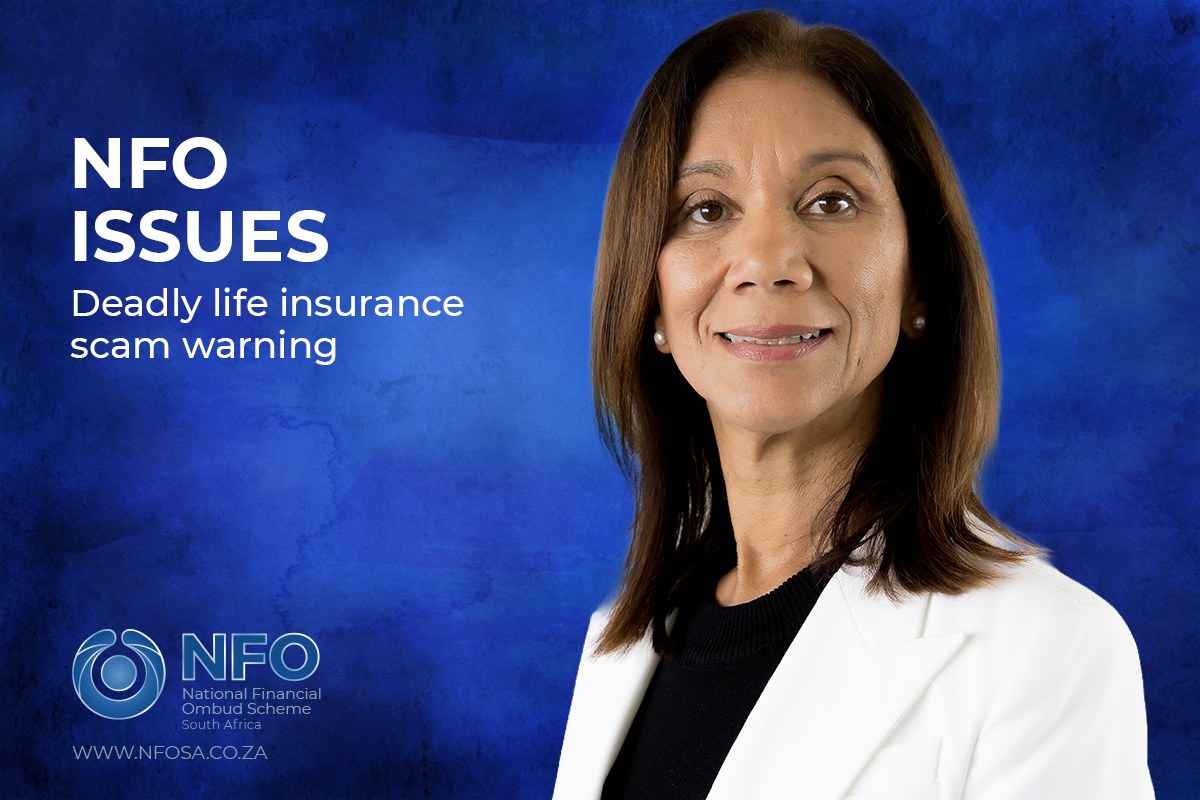
Denise Gabriels, Lead Ombud, Life Insurance Division of the NFO, said the NFO has set out a firm position: if a criminal case is opened against a beneficiary, it will not investigate his or her complaint while police investigations or court proceedings remain active.
“At the same time, the NFO cautions that justice delayed must not become justice denied.
“Where probes drag on unreasonably, or where police confirm that the beneficiary is not a suspect, insurers may be obliged to assess claims on their merits rather than leave families stranded in uncertainty,” she said.
Balancing Public Policy and Fairness
The NFO continues to confront life insurance disputes where troubling allegations surface – that a beneficiary may have played a role in the insured’s death, or that the passing occurred under suspicious circumstances. These so‑called “money for murder” cases strike at the heart of public policy, demanding a delicate balance between competing legal principles and the integrity of justice.
According to the Association for Savings and Investment South Africa (ASISA), South African life insurers detected 38 murder-for-money cases in 2024, up from 14 cases identified in 2023.
South African law has long recognised the principle that no person should be permitted to benefit from his or her own unlawful conduct. Accordingly, a person who intentionally causes the death of another should not be allowed to profit from that death through inheritance or insurance proceeds.
At the same time, allegations alone do not constitute proof of wrongdoing. The NFO remains committed to ensuring that all parties are treated fairly and that complaints are resolved in a manner that is consistent with the law, public policy, and the principles of natural justice.
NFO’s Approach to Pending Criminal Investigations
When it comes to the NFO’s attention that a beneficiary has not been cleared of suspicion concerning the death of the deceased who was the life assured, the NFO will generally refrain from making a ruling in favour of that beneficiary while the matter remains under investigation by SAPS or while criminal proceedings are pending before the courts.
In such circumstances, the NFO will ordinarily advise the beneficiary that the complaint process should await the outcome of the criminal proceedings. The beneficiary may return to the NFO once the criminal matter has been finalised through a verdict by a court; the withdrawal of criminal charges; a decision by the National Prosecuting Authority not to prosecute and the issuing of a certificate of nolle prosequi; or any other final disposition of the criminal matter.
This approach serves to protect the integrity of both the criminal justice system and the complaint-resolution process by avoiding inconsistent outcomes and ensuring that allegations of serious criminal conduct are appropriately investigated by the relevant authorities.
Where Criminal Proceedings Are Unreasonably Delayed
Gabriels was at pains to point out that the NFO is mindful that criminal investigations and prosecutions can sometimes take many years to conclude. In some matters, investigations may remain unresolved for lengthy periods through no fault of the claimant.
“It would be unjust for insurers and beneficiaries to remain in a state of uncertainty indefinitely while awaiting the outcome of a criminal investigation that shows little progress.
“Accordingly, where there has been an unreasonable delay in finalising the criminal matter, the NFO may require the insurer to assess the claim on its merits based on the available evidence and the terms and conditions of the policy.
“This approach recognises that while public policy requires vigilance against fraudulent and unlawful claims, indefinite delays may also undermine the rights of innocent policyholders and beneficiaries,” Gabriels said.
Each matter will nevertheless be considered on its own facts, taking into account the available evidence, the status of the criminal investigation, the interests of other affected parties and fairness.
Lessons from More Than a Decade of Reported Cases
For more than a decade, South Africans have been exposed to media reports concerning individuals who allegedly arranged or participated in the deaths of insured persons to obtain insurance proceeds.
These reports have highlighted the devastating social consequences of insurance-related crime and have raised legitimate concerns regarding whether additional safeguards are necessary within the life insurance industry.
A Call for Stronger Consumer Protection Measures
In the NFO’s view, one of the most effective safeguards aimed at reducing opportunities for abuse before policies are issued, would be a requirement that insurers obtain the informed consent of the life assured whenever cover is taken out on his or her life by another person.
Such a requirement would ensure that individuals are aware that insurance cover exists on their lives, understand who has taken out the policy, and know the extent of the cover that has been procured.
“A mandatory consent requirement would enhance transparency, strengthen consumer protection, reduce opportunities for fraud and abuse, and assist insurers in verifying the legitimacy of policies at inception.
“While many insurers have processes aimed at confirming insurable interest and preventing fraud, industry practices are not always uniform. The NFO believes that a consistent regulatory framework would improve standards across the industry and promote better outcomes for consumers,” Gabriels said.
Accordingly, the NFO believes that the Financial Sector Conduct Authority (FSCA), in consultation with stakeholders, should consider introducing conduct standards or regulatory requirements mandating proof of informed consent by the life assured before a policy is issued on that person’s life. Such measures would enhance compliance, improve accountability and strengthen public confidence in the life insurance industry.
Contact details for the NFO:
Telephone: 0860-800-900
WhatsApp: +27 (0) 76 574 8055
Email: [email protected]